
Which lot, which unit, where it has been, who holds it — one answer.
In Zeflash a serial number lives inside a batch inside a pack, not instead of them — so a returned unit tells you its lot, its carton and pallet, its quality results, its warranty, and whether it was ever recalled. Every capability is a switch: a hardware store never sees batch fields; a regulated exporter turns everything on.
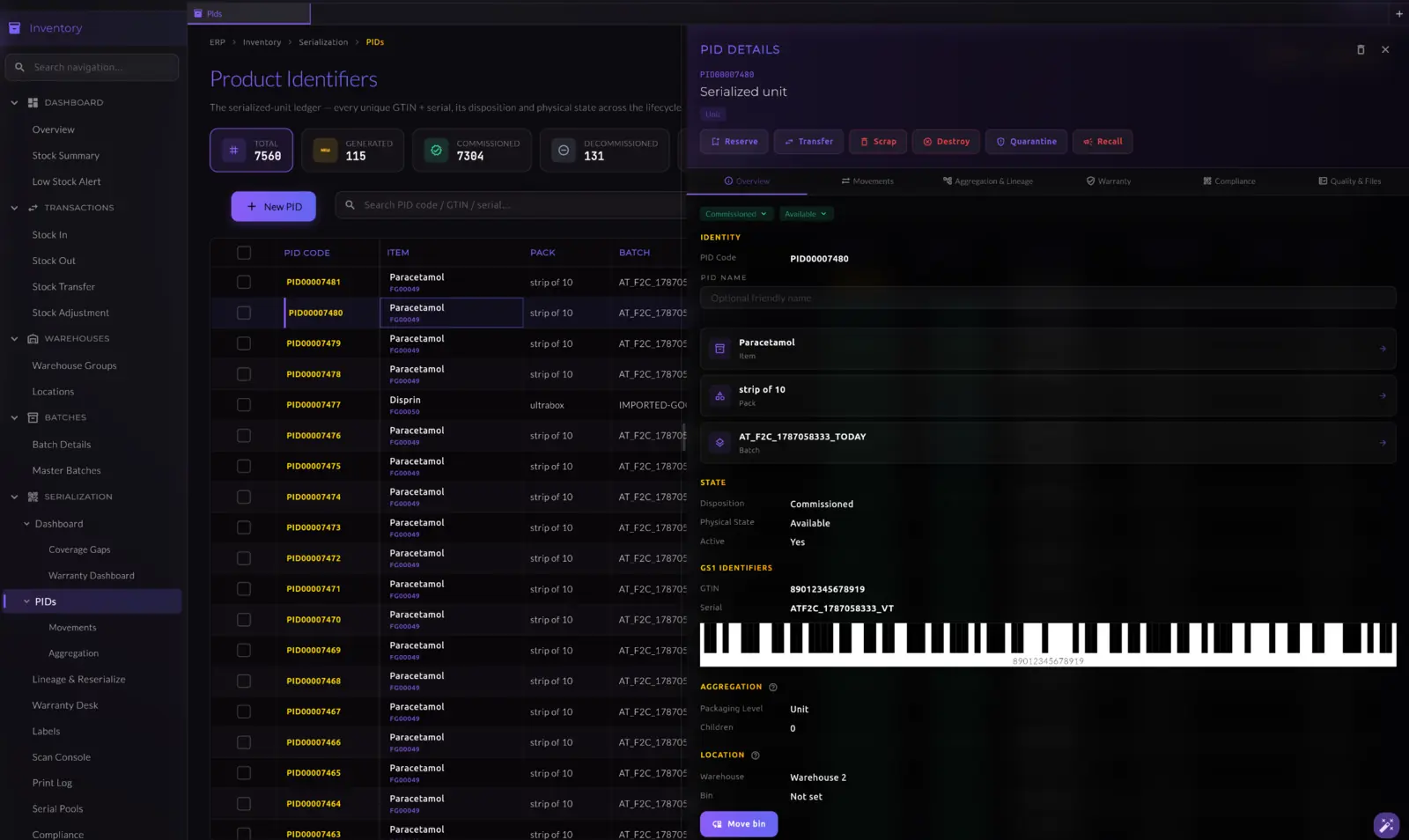 Item, pack and batch, linked
Disposition and physical state, kept apart
GTIN and serial, GS1-native
Item, pack and batch, linked
Disposition and physical state, kept apart
GTIN and serial, GS1-native
What it does
- Every batch records its own opening quantity and value, so cost of goods and margins are correct per lot, and keeps the supplier's own lot number so a manufacturer's recall reference finds every affected batch in one search.
- Expiry computed from manufacturing date and shelf life, moving to near-expiry and expired automatically — 90 days for pharma, 2 days for dairy — with First-Expiry-First-Out picking.
- Two life stories per unit: identity, and physical journey through stock, reservation, picking, packing, shipping, delivery, return, quarantine, recall and scrap.
- Units nest into inner packs, cases and pallets; scanning one pallet label reveals all 1,152 units inside, and a dock check reports exactly which are missing or don't belong.
- Recalls run as campaigns — regulator reference, class and scope, electronic signatures on announce and close, a roster of every holder, and a recovery curve tracked daily against a frozen denominator.
- Warranties start at the customer's actual purchase date, follow the unit on resale, and feed a warranty desk that tracks claims through repair, replacement, parts and cost.
Warehouses and stock
- Warehouse types cover godowns, retail counters, factories and job-work locations.
- A warehouse starts as one location and upgrades to zones, then to barcoded bins — aisle, rack, shelf, bin — with no data loss; a worker scans a bin barcode on a phone and gets its full context instantly.
- Receiving and shipping can be one step or multi-step — receive, quality check, stock; pick, pack, ship — per warehouse, so lab checks happen before goods become sellable.
- Stock alerts — minimum, maximum, reorder point, safety stock — per product per warehouse, or once for a whole region.
- Accounting for stock, cost of goods, adjustments and scrap resolves through a clear chain, and the system tells you exactly which level supplied each account.
Also built in
- The stock ledger itself — every movement in posting order, valuation never recomputed backwards, negative-stock control per book, landed cost onto received batches, count sheets with frozen quantities.
- Batch locking on first transaction and auto-batch on receipt.
- Reservations.
- Closest-bin putaway.
- Sending recall notifications to holders.
- A public consumer verification page.
- Auto-serialisation on production completion.
- Warranty parts drawn from stock and billed.
GS1 identifiers — GTIN, SSCC, GLN — with EPCIS event exchange in both directions, so a distributor or regulator gets a standards-based history file and a supplier's shipment file is ingested before the truck arrives. DSCSA and EU-FMD serialisation.
iVEDA export traceability, drug schedules H, H1 and X recorded on the batch, and per-batch pricing for short-expiry clearance.
Talk to us about inventory.
Bring the hardest thing you have had to prove — the lot that failed, the return nobody could place, the audit that cost you a week. That is the demo.