AI-NATIVE ERP FOR REGULATED INDUSTRIES

Prove every batch.
Trace every unit.
Answer every auditor.

Zeflash is an AI-native ERP for manufacturers and distributors in regulated industries — batches, serial numbers, quality, recipes, pricing, books and tax in one system that knows the rules of the country you operate in, built so the proof still exists years later.

A serial inside a batch, not instead of one A quality lab inside the ERP Five country profiles, India at depth

Built for the industries where proof is the product.

Every industry has its own rules, its own units and its own auditor. Pick yours.

Regulated manufacturing runs on proof.

Which lot, which unit, which certificate, which rule was in force that day — the answer has to exist years later, and it has to be the same answer every time.

Zeflash puts products, batches, serial numbers, warehouses, quality, recipes, pricing, schemes, books and tax in one system built for that proof — with intelligence in the core, so documents read themselves, the system knows your screens, and routine work happens with an audit trail.

It is global by design: company calendars, currencies, tax regimes and traceability standards for India, the United States, the United Kingdom, the UAE and Australia. And it is Indian by depth: MRP and the stockist price chain, GST document rules, price-controlled drugs, job-work, the 15-month first financial year.

One system, from the shop floor to the trial balance.

Not a suite of products bolted together — one data model where a quality failure quarantines a batch, and the batch knows what it cost.

An inspectionfailsThe batchis quarantinedThe certificateis versionedThe invoicetakes its numberThe ledgerpostsONE RECORD · ONE CAUSE · ONE PROOF
Not a suite of products passing files to each other — one data model, where every outcome still names the thing that caused it.

Inside the product.

Screens from the application, in the dark interface your team will spend its day in.

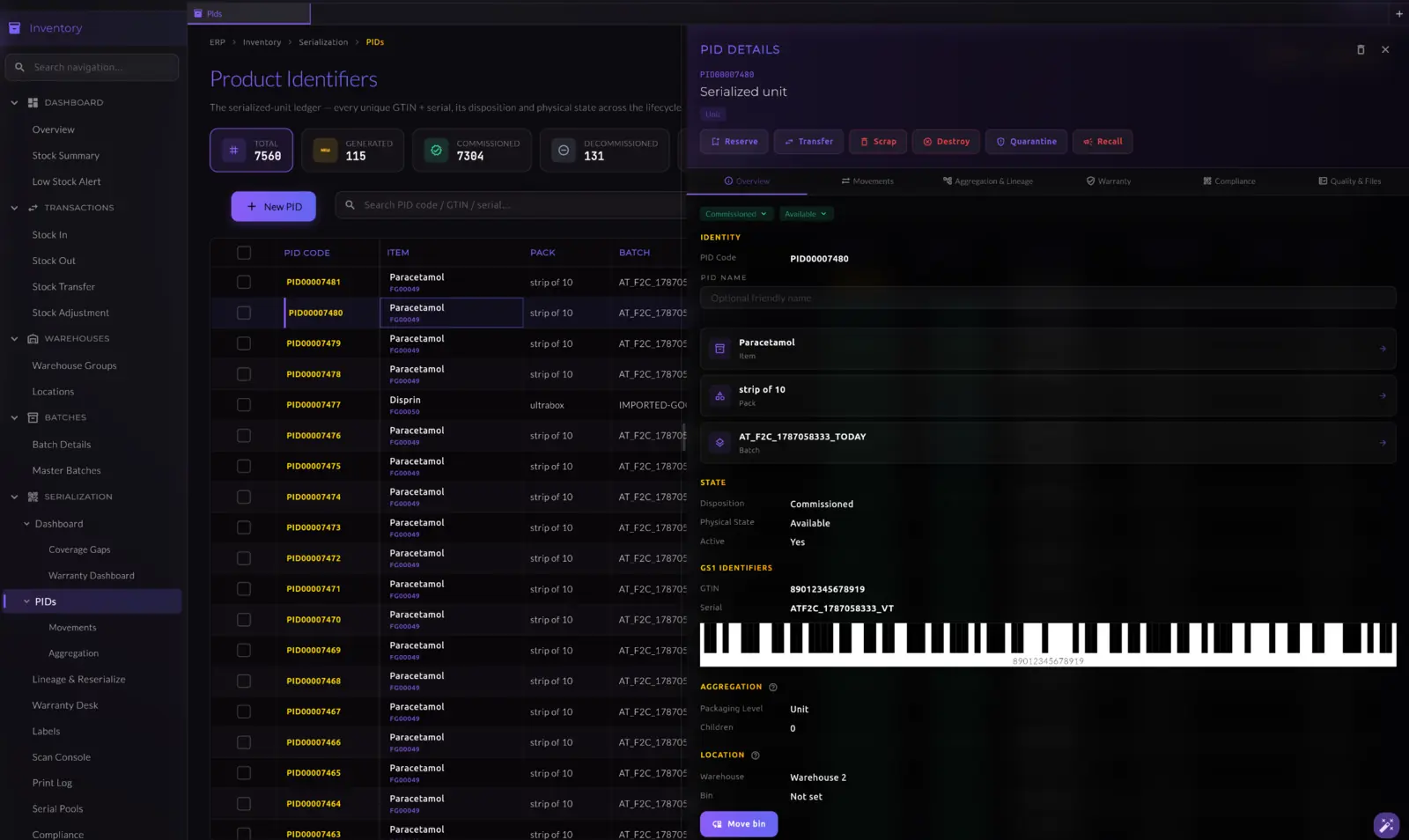
Every unit, inside its batch, inside its pack — the Zeflash application Item, pack and batch, linked Disposition and physical state, kept apart GTIN and serial, GS1-native

Every unit, inside its batch, inside its pack

The serialized-unit ledger: each unit’s GTIN and serial, with its disposition and its physical state tracked as two separate stories, the item, pack and batch it belongs to, and its aggregation, warranty and compliance history one tab away.

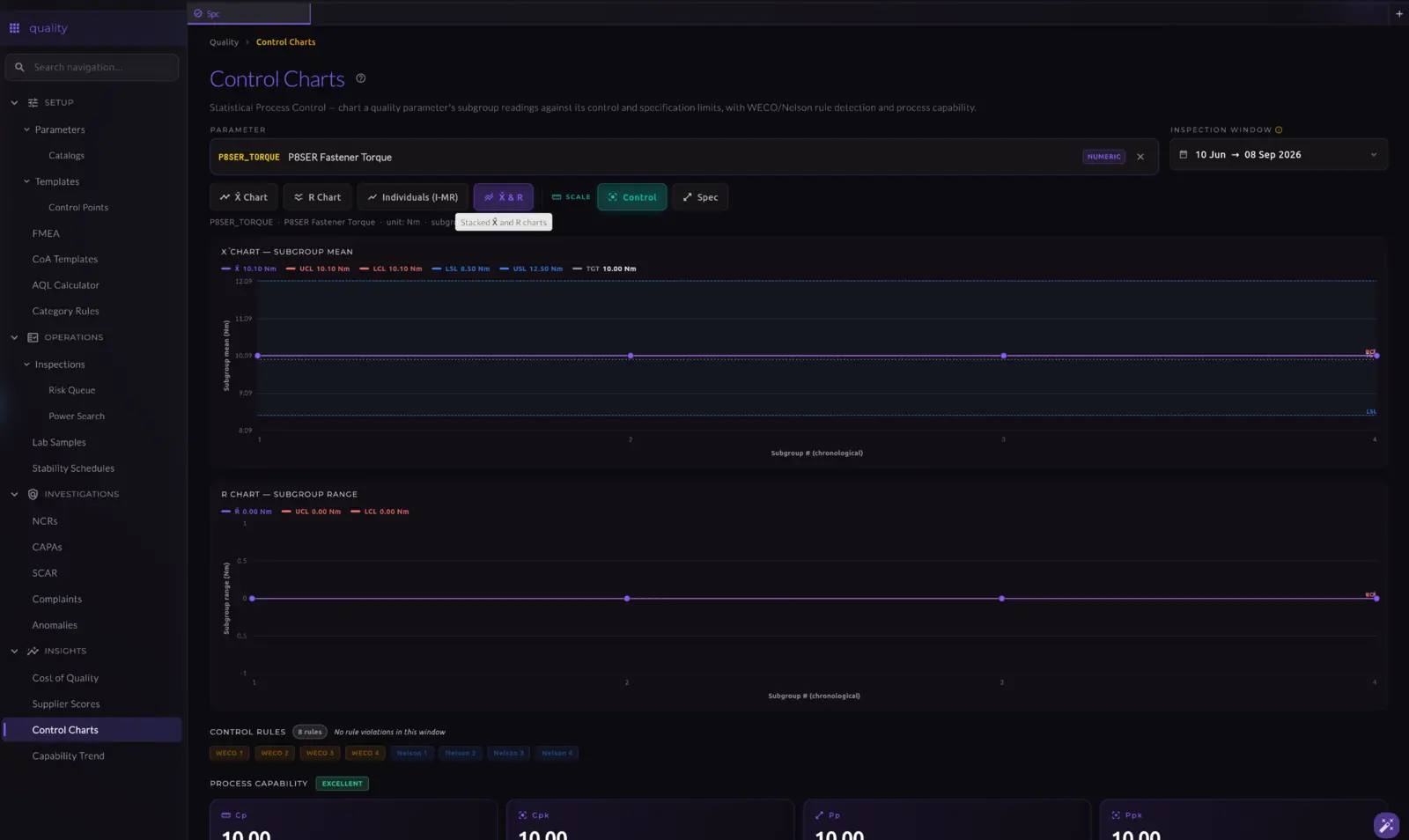
Statistical process control, built in — the Zeflash application Any parameter, its own limits Control and spec limits

Statistical process control, built in

A quality parameter’s subgroup readings charted against its control and specification limits, with WECO and Nelson rule detection and process capability tracked as a trend.

Why this customer got this price — the Zeflash application Which layer won, and why The reason, on the record

Why this customer got this price

The resolution path names every layer the resolver checked — negotiated party price, customer group, price list, standing rate — which one won, and the reason each of the others was skipped.

A partner that thinks with you, not a chatbot bolted on.

Bring it a business problem — how to raise a product’s margin without touching quality — and it works the problem with you. It has your costs, recipes, suppliers, quality results and sales in front of it, it can read the market outside, and it comes back with the levers, the numbers behind each one, and the action items. Every recommendation traces to your own operations.

HOW IT WORKS
ASK IT A BUSINESS PROBLEM

How do I raise the margin on this product without touching quality?

Renegotiate the API supplier ₹3.20 a strip traces to: purchase history · supplier score
Move to the 12-count pack +2.1 pts margin traces to: pack costs · sales mix
Trim overfill on line 2 ₹0.40 a strip traces to: routing scrap · inspection results

Three action items, each with its source.

Illustrative. The levers, the numbers behind them and the records each one rests on come from your own operations.

Built so proof does not depend on anyone remembering to be careful.

A database per customer

Your data is not a row with a tenant column. It is its own database, and which customer a request belongs to comes from the signed login.

Cause and effect, permanently

An append-only ledger records what caused what across the system. Entries are never edited or deleted.

Controls that are structural

Regulatory switches cannot be flipped by an ordinary settings admin. Nobody can grant a permission they don't hold.

People who have done this before

Four decades of enterprise software for Indian MSMEs behind the product, advised by engineers and data scientists at NVIDIA, HighLevel and Grab.

Meet the team

Nothing you have built is lost. Nothing you do not need is switched on.

Most businesses we meet run on Tally, a few spreadsheets and somebody who remembers. Here is what changes, and what does not.

01

Your books come across

The Tally importer reads your backup: parties and ledgers, stock with its batches and expiry, bill-wise outstandings with their due dates and ageing. Your trial balance becomes the opening-balance document, and the books stay at zero while you finish.

02

Your spreadsheets become records

Stability samples, scheme budgets, certificates, supplier specs, the goods out with a karigar — the things the ledger never held — become records with a name, a timestamp and a cause. The answer is the same every time, years later.

03

Depth is a switch, not a rewrite

A hardware store never sees a batch field; a regulated exporter turns everything on. Start with one warehouse and a handful of items, and switch on serialisation, the quality lab and job-work when the trade demands them.

Tell us what you make, and what you have to prove.

We will show you the system against your own batches, your own certificates and your own rules.