
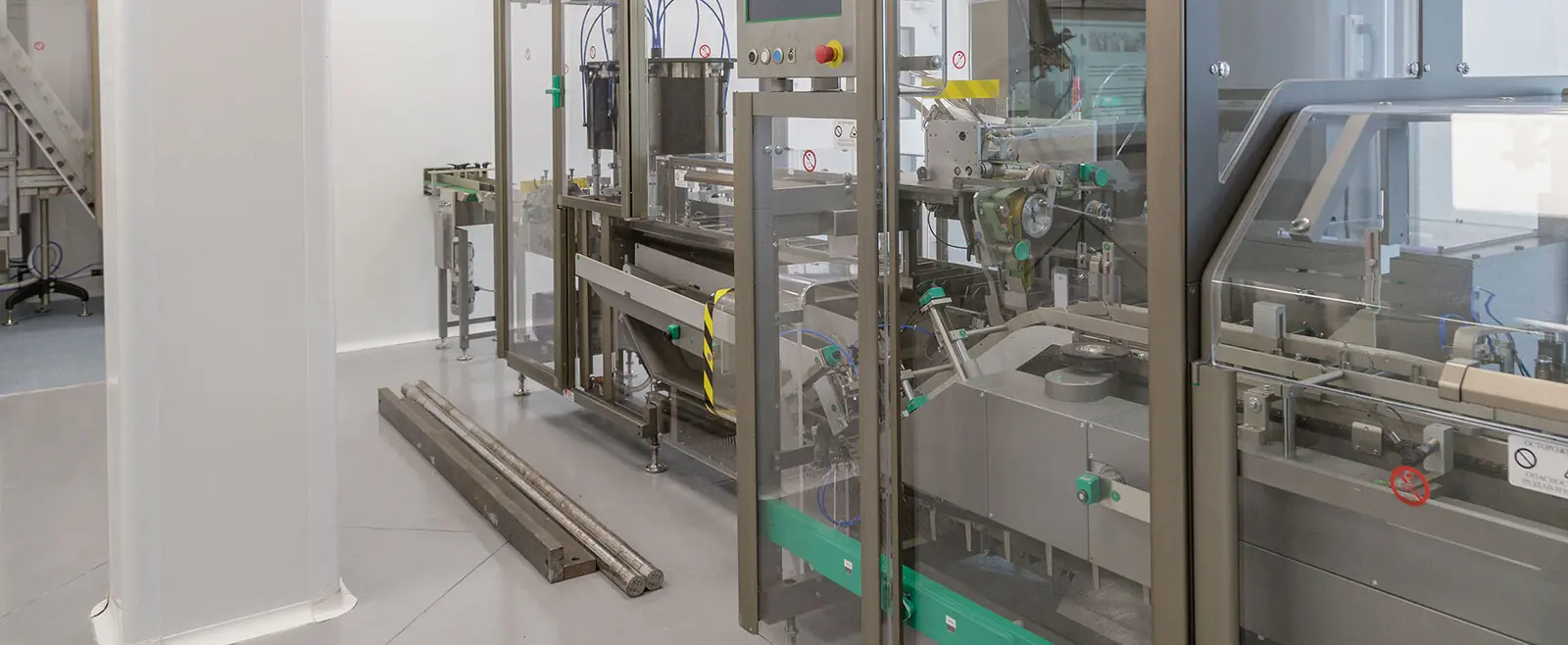
Pharmaceutical manufacturing
Every batch must be proven — made against the right process, tested against the right spec, certified, and traceable to the unit — and the proof must survive an inspection years later.
The things we hear most in this trade.
- “Our certificates are Word documents.
- “Which version of the process sheet was this batch made against?
- “The inspector asked who approved this deviation and we had to search email.
- “Stability samples are tracked in a spreadsheet.
- “Serialization is a separate system that doesn't know our batches.
Capability, and the outcome it buys you.
A tamper-evident Certificate of Analysis per approved inspection — numbered per financial year, fingerprinted, version-chained, verifiable in one click
an inspector's "was this ever altered?" is answered per version.
Every edit to a live process sheet is versioned with an immutable snapshot; batches pin to a version
"which process card?" always has one answer.
Inspections triggered automatically — every lot, first lot from a new supplier, every Nth lot — with QA approval, justified overrides and frozen results
deviations carry who, why and a signature.
Non-conformances, corrective and preventive actions with 30/60/90-day effectiveness checks, risk analysis and lab-sample chain of custody, each closed with an electronic signature per 21 CFR Part 11
the regulator's paperwork is the system's paperwork.
Stability studies at 3/6/9/12/18/24 months per ICH with due and overdue tracking
no spreadsheet.
A serial number inside a batch inside a pack; Unit to Inner Pack to Case to Pallet aggregation; GS1 EPCIS event exchange
serialization knows the batch, the certificate and the expiry.
Recalls run as campaigns — regulator reference, class, scope, e-signed announce and close, a roster of every holder, a daily recovery curve
a recall is a workflow, not a war room.
Scrap cascades backwards through the routing (1% at compression, 2% at coating, 3% at sizing means 7.3% more input)
no short batches.
Supplier-specific specs (assay 99.5 for one supplier, 99.2 for another) pre-filled with provenance; suppliers scored into Preferred, Standard, Probation or Blocked
supplier qualification is continuous.
Separation of duties: an inspector works a finding, only a Quality Lead approves; regulatory switches cannot be flipped by a settings admin
controls are structural.
A batch of Paracetamol 500 mg comes off the line against routing version 4. Incoming assay and moisture were pre-filled with the supplier's agreed limits; the inspection passed, QA approved, and the certificate COA/2026-27/00042 was generated, watermarked RELEASED and fingerprinted. 1,000 units are serialised inside the batch, cased and palletised; the pallet label reveals all 1,152 units. A month later the lab re-runs one test; QA reissues the certificate with a reason, version 1 is watermarked SUPERSEDED. When an inspector asks, the chain-verify report answers per version.
The standards and regulations this industry answers to.
- FDA 21 CFR Part 11
- EU GMP
- ICH stability
- ANSI Z1.4 sampling
- DSCSA and EU-FMD serialisation
- GS1
- iVEDA export traceability
- Drug schedules H/H1/X
- DPCO price caps
Talk to us about pharma manufacturing.
Bring the hardest thing you have had to prove — the lot that failed, the return nobody could place, the audit that cost you a week. That is the demo.